
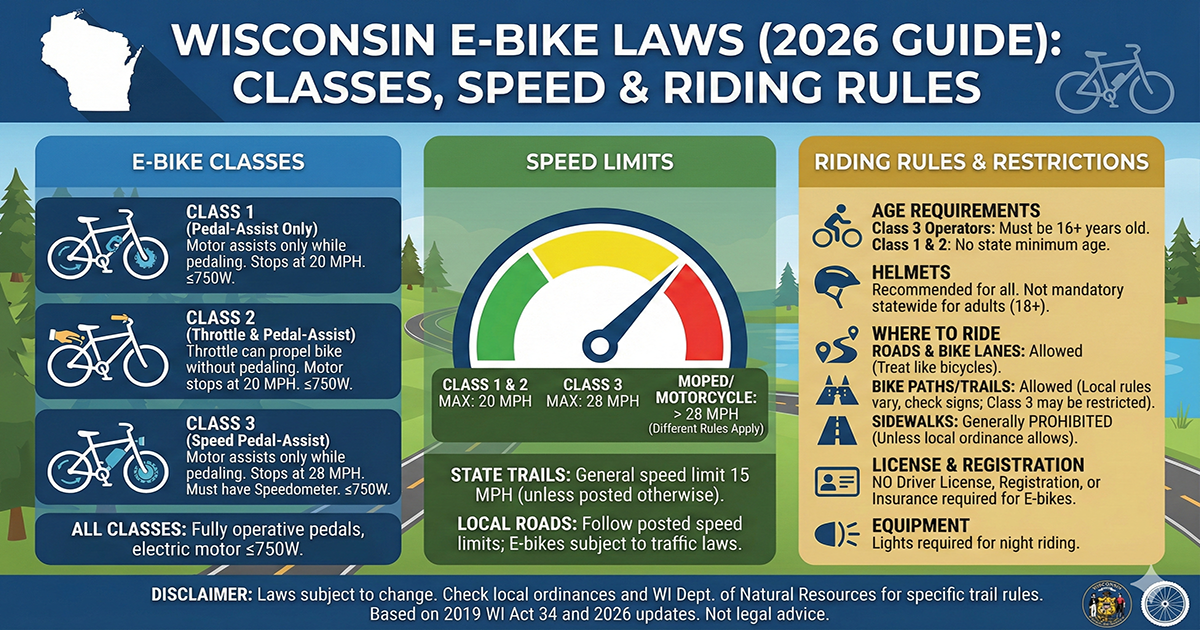
Wisconsin E-Bike Laws 2026
Wisconsin recognizes Class 1, Class 2 and Class 3 electric bicycles with motors up to 750 watts. Legal e-bikes generally receive the same road rights and duties as bicycles, but Class 3 has a minimum operator age of 16, sidewalks require local authorization, and Wisconsin DNR trail rules are more restrictive than ordinary road and bikeway rules.
Wisconsin sidewalk and state-trail rules are often misstated
Wisconsin does not generally allow bicycle or e-bike riding on sidewalks unless the local government has adopted an ordinance permitting it. Wisconsin DNR trails also have their own rules: Class 1 and Class 3 e-bikes are permitted with the motor engaged only on designated bicycle trails, generally subject to a 15 mph speed limit.
Wisconsin’s Class 1, Class 2 and Class 3 e-bike system
Wisconsin Statute §340.01(15ph) defines an electric bicycle as a bicycle with fully operative pedals for human propulsion and an electric motor of 750 watts or less that qualifies as Class 1, Class 2 or Class 3.
Class 1
The motor assists only while the rider is pedaling.
Assistance ends at 20 mph.Class 2
The bicycle may be powered solely by the electric motor.
Motor assistance ends at 20 mph.Class 3
The motor assists only while the rider is pedaling.
Assistance ends at 28 mph.Where can you ride an e-bike in Wisconsin?
Wisconsin §346.806 generally gives an electric bicycle and its operator the same rights, privileges and duties as a traditional bicycle and bicycle rider, unless another rule specifically provides otherwise.
| Location | General Wisconsin Rule | Important Exception |
|---|---|---|
| Public roads | Generally allowed | E-bike riders must obey Wisconsin bicycle and traffic laws. |
| Bicycle lanes | Generally allowed | Follow local signs and facility restrictions. |
| Public bikeways | Can be used with motor engaged | DNR, WisDOT, municipalities and counties may impose restrictions on bikeways under their jurisdiction. |
| Interstate / controlled-access highways | Restricted | Wisconsin prohibits bicycles from certain interstate, expressway and controlled-access facilities. |
| Sidewalks | Not allowed by default | A municipality must specifically authorize bicycle sidewalk riding by ordinance. |
Wisconsin state trail e-bike rules
Wisconsin DNR does not simply open every bicycle trail to every e-bike class. Its current trail policy specifically authorizes Class 1 and Class 3 e-bikes on many listed bicycle trails.
Class 1 and Class 3 are allowed on many designated trails.
When the motor is engaged, those riders must observe the DNR’s trail-specific rules and a speed of less than 15 mph. The individual trail listing still controls.
- Class 1: allowed on many DNR bicycle trails identified as open to e-bikes.
- Class 3: also allowed on many designated DNR bicycle trails despite its higher assisted road speed.
- Class 2: is not included in the DNR’s general Class 1/Class 3 motor-assisted trail authorization.
- Speed: Class 1 and Class 3 must remain below 15 mph while the motor is engaged on trails governed by the DNR rule.
- Motor off: DNR states that electric bicycles used without the motor engaged are allowed on bicycle trails.
- Mobility disability: riders who use an e-bike because of a mobility disability may be able to obtain a permit for trails otherwise closed to e-bikes.
Wisconsin trail access varies dramatically by property
Wisconsin DNR publishes an unusually useful trail-by-trail table. Many rail-trails permit e-bikes, while some off-road and mountain bike systems remain closed to electric assistance.
Many rail-trails are open
Examples currently listed as e-bike-accessible include the 400 State Trail, Badger State Trail, Capital City State Trail, Elroy-Sparta State Trail, Glacial Drumlin State Trail, Great River State Trail and Military Ridge State Trail.
Some off-road trails remain closed
Examples currently shown as closed to e-bikes include certain trails at Devil’s Lake State Park, Governor Dodge State Park, High Cliff State Park and several Kettle Moraine locations.
Some MTB systems permit them
DNR currently lists e-bike access on constructed mountain-bike trails at properties including Blue Mound State Park, Brule River State Forest, Kinnickinnic State Park, Peninsula State Park and Willow River State Park.
Trail passes
Riders age 16 and older need a Wisconsin state trail pass on designated fee trails. For 2026, DNR lists the pass at $25 annually or $5 daily.
Can you ride an e-bike on a sidewalk in Wisconsin?
Wisconsin sidewalk riding is prohibited unless locally authorized.
Wisconsin DOT explains that bicycle riding on a sidewalk is illegal unless the community has adopted an ordinance specifically permitting it. Local permission can be restricted by rider age, location or adjacent property type. Because Wisconsin generally gives e-bikes the same rights and duties as bicycles, riders should confirm the applicable city or village ordinance before using a sidewalk.
Pedestrians have priority
Where sidewalk bicycle riding is legally permitted, riders must yield the right-of-way to pedestrians.
Audible warning
A bicyclist overtaking a pedestrian on an authorized sidewalk must give an audible signal before passing.
Wisconsin e-bike age and helmet requirements
Class 3 minimum age
A person under 16 years old may not operate a Class 3 electric bicycle in Wisconsin.
Younger Class 3 passengers
A person under 16 may ride as a passenger on a Class 3 e-bike that is designed to accommodate passengers.
No general statewide e-bike helmet law
Wisconsin’s statewide e-bike statutes do not impose a general helmet requirement on Class 1, Class 2 or Class 3 operators.
Local ordinances, events, schools or trail systems may impose their own safety requirements.
Class 1 & Class 2
Wisconsin’s statewide Class 3 minimum age does not apply to ordinary Class 1 or Class 2 operation.
Wisconsin e-bike equipment requirements
Permanent e-bike label
Manufacturers and distributors must permanently label an electric bicycle with its class number, the speed at which motor assistance ends and the motor wattage.
If a modification changes the bicycle’s class, a revised classification label must be applied.
Class 3 speedometer
A Class 3 e-bike must have a speedometer that reasonably accurately displays speed in miles per hour.
Night lighting
- White front lamp visible from at least 500 feet.
- Rear red reflector visible from 50 to 500 feet under lawful upper-beam headlights.
- A steady or flashing red rear lamp visible from 500 feet may be used instead of the rear reflector.
Working brake
A bicycle must have a brake in good working condition that is adequate to control its movement and stop it whenever necessary.
Motor shutoff behavior
Wisconsin requires the motor to cease assistance or power when the brakes are applied or when the applicable control condition ends, including when a pedal-assist rider stops pedaling.
Overpowered vehicles
An electric two-wheeler exceeding Wisconsin’s 750-watt limit or three-class speed structure may fall under moped, motor-bicycle or motorcycle rules instead.
Wisconsin requires at least three feet when passing a bicycle
Three feet is the legal minimum—not the target maximum.
A motorist overtaking a bicycle traveling in the same direction must exercise due care, leave a safe distance and provide no less than three feet of clearance.
- Minimum passing clearance: 3 feet.
- The driver must maintain that clearance until safely past.
- Wisconsin DOT advises motorists to provide more room at higher speeds.
- Narrow travel lanes may require a motorist to change lanes rather than squeeze past a rider.
Wisconsin exempts compliant e-bikes from motor-vehicle paperwork
Wisconsin §346.806 expressly provides that electric-bicycle operators are not subject to the state’s motor-vehicle financial responsibility, operator-license, registration or certificate-of-title requirements.
Driver’s license
No Wisconsin driver’s license is required solely to operate a compliant Class 1, Class 2 or Class 3 electric bicycle.
Registration
Wisconsin DMV does not register compliant electric bicycles as motor vehicles.
Certificate of title
Wisconsin DMV does not issue a motor-vehicle title for a compliant electric bicycle.
Financial responsibility
Wisconsin’s ordinary motor-vehicle financial-responsibility requirements do not apply solely because a legal bicycle has electric assistance.
A 30+ mph electric dirt bike is not automatically a Wisconsin e-bike.
A legal Wisconsin electric bicycle must have fully operative pedals, a motor rated at 750 watts or less and fit the Class 1, Class 2 or Class 3 definition. Vehicles outside those limits may be classified as mopeds, motor bicycles, motorcycles or other motorized vehicles and can require different licensing, registration, insurance or operating rules.
E-bike laws in states bordering Wisconsin
Wisconsin borders Minnesota, Iowa, Illinois and Michigan. E-bike class systems may look similar, but trail access, sidewalk, age and helmet rules can change across the state line.
Related e-bike guides
Verify Wisconsin e-bike law at the source
This guide was fact-checked against Wisconsin statutes, Wisconsin Department of Transportation guidance and current Wisconsin DNR trail policies.
Frequently asked questions
What are Wisconsin’s three e-bike classes?
Class 1 provides pedal assistance up to 20 mph. Class 2 may propel the bicycle solely by the motor up to 20 mph. Class 3 provides pedal assistance up to 28 mph. Wisconsin limits electric bicycle motors to 750 watts or less.
How old do you have to be to ride a Class 3 e-bike in Wisconsin?
A person must be at least 16 years old to operate a Class 3 electric bicycle in Wisconsin. A person under 16 may ride as a passenger on a Class 3 bike designed to carry passengers.
Does Wisconsin require a helmet on an e-bike?
Wisconsin’s statewide electric-bicycle statutes do not impose a general helmet requirement for Class 1, Class 2 or Class 3 riders. Local rules or organized activities may impose separate helmet requirements.
Are e-bikes legal on Wisconsin roads?
Yes. Wisconsin generally gives electric bicycles the same road rights and duties as traditional bicycles. Riders must obey ordinary bicycle and traffic laws and avoid facilities where bicycles are prohibited.
Can you ride an e-bike on a Wisconsin sidewalk?
Not by statewide default. Wisconsin DOT says bicycle sidewalk riding is illegal unless the local government has adopted an ordinance permitting it. Local permission may also contain age or location restrictions.
Which e-bike classes are allowed on Wisconsin DNR trails?
Wisconsin DNR currently permits Class 1 and Class 3 e-bikes with the motor engaged on many specifically designated bicycle trails, generally at speeds below 15 mph. Class 2 is not part of that general DNR authorization. Riders should check the individual trail listing before riding.
Can I ride an e-bike with the motor turned off on Wisconsin trails?
Wisconsin DNR says electric bicycles used without the motor engaged are allowed on bicycle trails, even where motor-assisted e-bike use is not authorized.
Do Wisconsin e-bikes require a driver’s license or registration?
No. Wisconsin exempts compliant electric bicycles from operator licensing, motor-vehicle registration, certificates of title and financial-responsibility requirements.
Does a Class 3 e-bike need a speedometer in Wisconsin?
Yes. Wisconsin requires a Class 3 electric bicycle to have a speedometer that reasonably accurately registers the bicycle’s speed in miles per hour.
How much room must Wisconsin drivers give a bicyclist?
Wisconsin requires motorists overtaking a bicycle to leave a safe distance of at least three feet and maintain that clearance until safely past.
Are throttles legal on Wisconsin e-bikes?
Yes. Wisconsin Class 2 e-bikes may be powered solely by the motor, but motor assistance must cease at 20 mph. Class 1 and Class 3 are pedal-assist classes.
Last fact-checked September 27, 2026. This guide is educational information, not legal advice. Wisconsin statutes, local ordinances, DNR trail policies, WisDOT rules, closures and posted restrictions can change. Verify current requirements with the Wisconsin Legislature, Wisconsin DOT, Wisconsin DNR or the agency responsible for the route you plan to ride.