
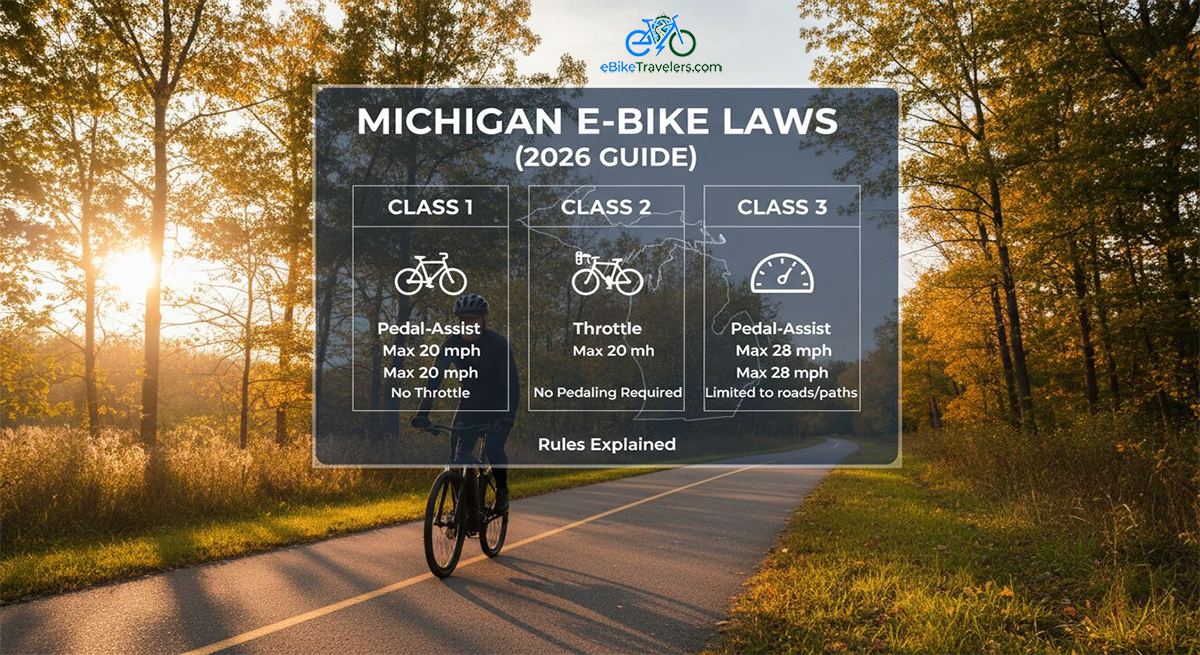
Michigan E-Bike Laws 2026
Michigan uses a three-class electric bicycle system with a 750-watt ceiling, special Class 3 age and helmet rules, and a layered trail-access system that depends on both state statute and the land manager. Michigan DNR currently gives Class 1 e-bikes much broader access on state-managed bicycle trails than the older statewide baseline alone suggests.
Michigan’s Class 1, Class 2 and Class 3 e-bike system
Michigan Compiled Laws §257.13e defines an electric bicycle as a device with a seat or saddle, fully operable pedals and an electric motor rated at no more than 750 watts.
Class 1
The motor provides assistance only while the rider is pedaling.
Assistance ends at 20 mph.Class 2
The motor may propel the bicycle whether or not the rider is pedaling.
Motor propulsion is limited to 20 mph.Class 3
The motor provides assistance only while the rider is pedaling.
Assistance ends at 28 mph.Where can you ride an e-bike in Michigan?
Michigan generally gives an e-bike rider the same duties as a bicycle rider, but trail access changes substantially by class, surface and land manager.
| Location | Class 1 | Class 2 | Class 3 |
|---|---|---|---|
| Highway portions open to bicycles | Allowed | Allowed | Allowed |
| Bike lanes & shoulders | Allowed | Allowed | Allowed |
| Asphalt / crushed-limestone linear trails | Allowed by statute | Only if authorized | Only if authorized |
| Rail trails | Allowed by statute | Only if authorized | Only if authorized |
| Natural-surface nonmotorized trails | Statewide baseline prohibits e-bike operation unless the local authority or state agency controlling the trail specifically allows and regulates e-bike use. Michigan DNR has adopted a broader Class 1 policy on many DNR-managed trails. | ||
| Sidewalks | E-bike riders generally follow bicycle rules. Bicycle riders must yield to pedestrians and give an audible warning when passing, and sidewalk riding may be prohibited by posted traffic-control devices or local restrictions. | ||
Michigan DNR e-bike trail rules
DNR-managed state parks, recreation areas and state forests now have a specific operating policy that is especially important for mountain-bike and natural-surface riders.
Class 1 has the broadest state-managed trail access.
Michigan DNR says Class 1 e-bikes are allowed on state park, recreation area and state forest trails and pathways that permit traditional bicycles, subject to specified exceptions.
- Class 1: allowed on DNR-managed bicycle trails and pathways, subject to listed exceptions.
- Class 2: allowed on Class 1-access trails only for a rider with a qualifying mobility issue and a no-cost DNR permit.
- Class 3: not allowed on state-managed trails.
- DNR roads: Class 1, 2 and 3 e-bikes may use roads where traditional bicycles are permitted.
- Exceptions: state game/wildlife areas, congressionally authorized trails such as the North Country Trail and certain Pigeon River Country pathways are excluded from the broader Class 1 policy.
Why Michigan trail rules can look contradictory
The statute and DNR policy answer different questions.
Michigan’s Vehicle Code establishes the statewide baseline: Class 1 may use many surfaced linear trails, Class 2 and 3 require authorization, and e-bikes are restricted on natural-surface nonmotorized trails unless the land manager allows them. The DNR has exercised that management authority to allow Class 1 e-bikes on many additional DNR-managed bicycle trails.
Mackinac Island has separate e-bike restrictions
Michigan law specifically singles out Mackinac Island because of its long-standing restrictions on ordinary motor vehicles.
Do not assume ordinary Michigan road rules apply on Mackinac Island.
State law prohibits e-bike operation within Mackinac Island State Park unless the rider has the required permit or the Mackinac Island State Park Commission has otherwise authorized e-bike operation. The Commission may impose additional rules within its jurisdiction.
Michigan e-bike age and helmet laws
Class 3 minimum age
A rider must be at least 14 years old to operate a Class 3 electric bicycle.
A person under 14 may ride as a passenger on a Class 3 bike designed to carry passengers.
Class 3 helmet rule
An operator or passenger under 18 years old on a Class 3 e-bike must wear a properly fitted and fastened qualifying bicycle helmet.
Required e-bike label
New electric bicycles sold in Michigan must carry a permanent label showing the bike’s class, top assisted speed and motor wattage.
Modified bikes
If a modification changes the manufactured motor-powered speed capability or motor engagement, the bike must receive an appropriate replacement class label. A modified machine that no longer satisfies Michigan’s e-bike criteria is not treated as an electric bicycle.
Michigan bicycle equipment rules also matter to e-bike riders
Night lighting
- White front lamp visible from at least 500 feet.
- Red rear reflector visible from 100 to 600 feet under lawful low-beam headlights.
- An additional red rear lamp visible from 500 feet may also be used.
Brakes
Michigan requires a bicycle to have a brake capable of making the braked wheels skid on dry, level, clean pavement.
Bicycle traffic rules
Except where Michigan’s e-bike statute creates a specific exception, an e-bike rider is subject to the same Vehicle Code requirements as a bicycle rider.
Riding two abreast
Bicycle riders may ride no more than two abreast on a highway or street unless riding on a path or part of the roadway set aside for bicycles.
Do Michigan e-bikes require a license or registration?
A compliant Class 1, Class 2 or Class 3 electric bicycle is regulated as an electric bicycle rather than as a moped or motorcycle. Ordinary motor-vehicle driver’s-license, registration and title requirements do not apply merely because the bicycle has electric assistance.
Driver’s license
No driver’s license is required solely to operate a compliant e-bike.
Registration
A compliant e-bike is not registered as a motorcycle or moped.
Title / plate
Standard motor-vehicle title and license-plate requirements do not apply to a compliant electric bicycle.
E-motos are different
Michigan DNR warns that high-powered electric machines exceeding the e-bike definition can fall into moped, motorcycle or ORV rules.
A fast electric motorcycle is not an e-bike just because it has pedals.
Michigan DNR identifies electric machines exceeding 750 watts, exceeding 28 mph under motor assistance, operating primarily by throttle above 20 mph or lacking fully operable pedals as vehicles that fall outside the state’s e-bike framework.
E-bike laws in states bordering Michigan
Michigan shares land borders with Ohio, Indiana and Wisconsin. E-bike classifications may look similar, but age, helmet and trail rules can change across state lines.
Related e-bike guides
Verify Michigan e-bike law at the source
This page was fact-checked against the Michigan Vehicle Code and current Michigan DNR guidance.
Frequently asked questions
What are Michigan’s three e-bike classes?
Class 1 provides pedal assistance to 20 mph. Class 2 may propel the bicycle without pedaling up to 20 mph. Class 3 provides pedal assistance to 28 mph. A Michigan e-bike may use a motor rated at no more than 750 watts.
How old do you have to be to ride a Class 3 e-bike in Michigan?
A person must be at least 14 years old to operate a Class 3 electric bicycle. A younger person may ride as a passenger on a Class 3 e-bike designed to carry passengers.
Does Michigan require helmets on e-bikes?
Michigan requires Class 3 operators and passengers under age 18 to wear a qualifying bicycle helmet. The Vehicle Code does not impose that specific Class 3 helmet requirement on riders age 18 and older.
Can Class 1 e-bikes use Michigan DNR trails?
Generally yes. Michigan DNR currently permits Class 1 e-bikes on state park, recreation area and state forest trails and pathways where traditional bicycles are allowed, subject to listed exceptions.
Can a Class 2 e-bike use Michigan DNR trails?
Class 2 trail access on DNR-managed land is generally limited to riders with qualifying mobility issues who obtain the no-cost DNR permit. Class 2 e-bikes may use DNR roads where traditional bicycles are allowed.
Can a Class 3 e-bike use Michigan state-managed trails?
Michigan DNR states that Class 3 e-bikes are not allowed on state-managed trails. Class 3 e-bikes may use DNR-managed roads where traditional bicycles can be ridden.
Can e-bikes use natural-surface trails in Michigan?
Michigan’s statewide statute restricts e-bikes on nonmotorized natural-surface trails unless the responsible authority allows and regulates them. Michigan DNR has used that authority to allow Class 1 e-bikes on many DNR-managed trails that are open to traditional bicycles.
Can you ride an e-bike on Mackinac Island?
Mackinac Island is a special jurisdiction. E-bike use within Mackinac Island State Park requires authorization or the applicable permit from the Mackinac Island State Park Commission.
Do Michigan e-bikes require a driver’s license?
A compliant Class 1, Class 2 or Class 3 electric bicycle is regulated as an electric bicycle rather than a moped or motorcycle, so ordinary motor-vehicle licensing requirements do not apply merely because the bicycle has electric assistance.
Last fact-checked September 27, 2026. This guide is educational information, not legal advice. Michigan statutes, DNR land-use orders, local ordinances, trail policies and posted restrictions can change. Verify the current rule with the Michigan Legislature, Michigan DNR or the land manager responsible for the route you plan to ride.