
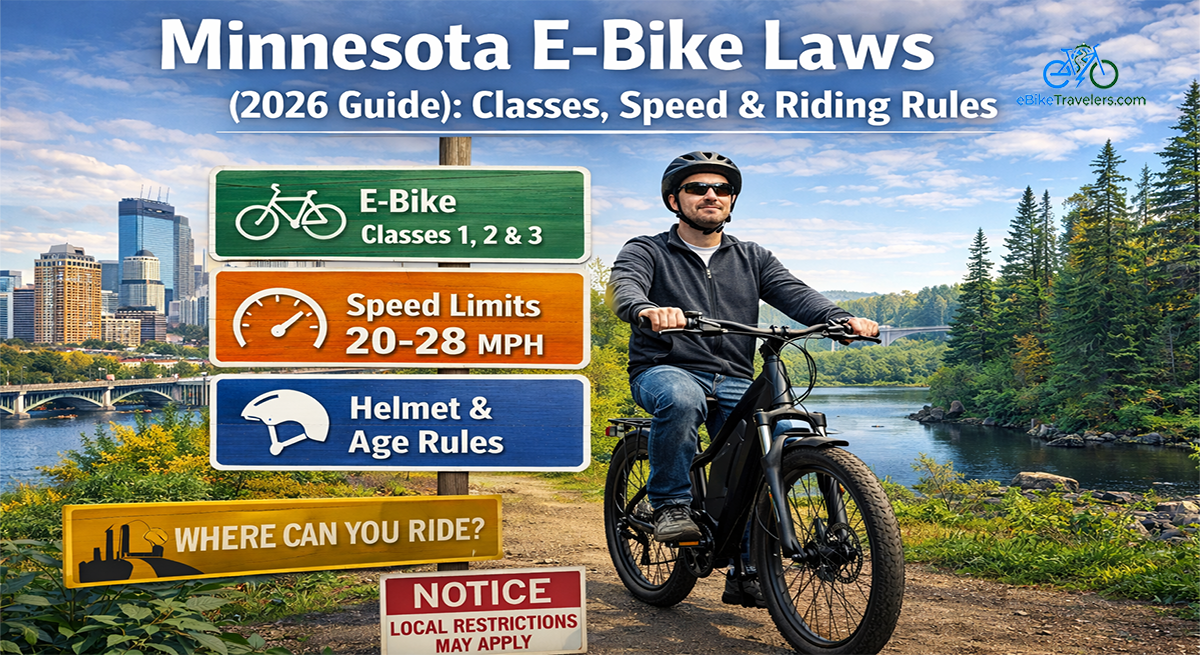
Minnesota E-Bike Laws 2026
Minnesota uses a three-class electric-assisted bicycle system, sets a statewide minimum operating age of 15, allows compliant e-bikes on roads and many bicycle facilities, and now includes battery-safety, labeling and modification requirements in its legal definition of an e-bike.
Two common Minnesota e-bike claims are outdated or incorrect
Minnesota does not currently impose a statewide helmet requirement on all e-bike riders under 18, and e-bikes are not simply prohibited from sidewalks statewide. Current law instead sets a minimum operator age of 15 and applies the state’s ordinary bicycle sidewalk rules.
Minnesota’s Class 1, Class 2 and Class 3 e-bike system
Minnesota Statutes §169.011 defines an electric-assisted bicycle as a two- or three-wheel bicycle with a saddle, fully operable pedals and an electric motor with a power output of no more than 750 watts. The bike must qualify as Class 1, Class 2, Class 3 or a compliant multiple-mode electric-assisted bicycle.
Class 1
Motor assistance is provided only while the rider is pedaling.
Assistance ends at 20 mph.Class 2
The motor may propel the bicycle even when the rider is not pedaling.
Motor assistance ends at 20 mph.Class 3
Motor assistance is provided only while the rider is pedaling.
Assistance ends at 28 mph.Where can you ride an e-bike in Minnesota?
Minnesota generally regulates compliant electric-assisted bicycles like ordinary bicycles, with additional class-specific rules for paths and natural-surface trails.
| Location | Class 1 | Class 2 | Class 3 |
|---|---|---|---|
| Roads & streets | Allowed | Allowed | Allowed |
| Road shoulders | Allowed | Allowed | Allowed |
| Bicycle lanes & bicycle routes | Allowed | Allowed | Allowed |
| Bicycle paths / shared-use paths | Allowed by default | Allowed by default | Allowed unless prohibited |
| Natural-surface nonmotorized trails | The local authority or state agency controlling the trail may regulate e-bike operation. Check the specific trail manager rather than relying only on the statewide class rule. | ||
Minnesota state trail e-bike rules
Minnesota DNR publishes a specific policy for designated state trails. Other DNR-managed lands such as state forests and wildlife management areas can use different rules.
Compliant e-bikes are allowed where normal bicycles are allowed.
Minnesota DNR says electric-assist and pedal-assist bicycles meeting Minnesota’s legal definition may use state trails or other locations where normal bicycles are permitted.
- Bike must have two or three wheels, a saddle and operable pedals.
- Motor output must be no more than 750 watts.
- Bike must qualify as Class 1, Class 2 or Class 3.
- Rider must be at least 15 years old.
- Riders should yield to pedestrians and slower users and give an audible signal before passing.
- Motorized cycles that do not meet Minnesota’s e-bike definition are not allowed on state trails where motor vehicles are prohibited.
Can you ride an e-bike on a sidewalk in Minnesota?
Minnesota’s statewide rule is more nuanced than a blanket sidewalk ban.
| Situation | Minnesota rule |
|---|---|
| Sidewalk outside a business district | Bicycle and compliant e-bike riding is generally permitted unless the local authority prohibits it. |
| Sidewalk in a business district | Riding is prohibited unless the local authority permits it. |
| Passing pedestrians | The rider must yield the right-of-way and give an audible signal when necessary before overtaking a pedestrian. |
| Local restrictions | Local authorities may prohibit bicycle and e-bike operation on sidewalks or crosswalks under their jurisdiction. |
Minnesota e-bike age and helmet requirements
Minimum operating age
A person under 15 years old may not operate an electric-assisted bicycle in Minnesota.
This minimum applies across Class 1, Class 2 and Class 3.
Helmet requirement
Minnesota’s current electric-assisted bicycle statute does not impose a general statewide helmet requirement for compliant e-bike operators.
Helmet rules for motorcycles, motorized bicycles and motorized scooters should not be automatically applied to legal e-bikes.
Local safety rules
Local authorities can regulate certain bicycle facilities and natural-surface trails, so riders should still check posted rules where they ride.
Helmet use is still recommended
Lack of a statewide e-bike helmet mandate does not mean riding without one is advisable. A properly fitted bicycle helmet is useful safety equipment for riders of every class.
Minnesota e-bike equipment requirements
Permanent class label
Manufacturers and distributors must permanently label an electric-assisted bicycle with its class, top assisted speed and motor wattage.
Multiple-mode bikes must identify the highest class or each class in which the bike is capable of operating.
Class 3 speedometer
Class 3 and multiple-mode e-bikes must have a speedometer displaying the bicycle’s speed in miles per hour.
Night lighting
- White front light visible from at least 500 feet.
- Red rear reflector visible from 100 to 600 feet.
- A front and rear lamp visible from 500 feet can satisfy the nighttime-lighting requirement.
- Side reflective material is required when visibility is insufficient to clearly see people and vehicles 500 feet ahead.
Brakes
A bicycle must have a rear brake or front-and-rear brakes capable of making a braked wheel skid on dry, level, clean pavement.
Battery safety and configurable e-bikes now matter under Minnesota law
Minnesota’s current definition goes beyond motor wattage and speed. It also addresses battery testing and bikes intentionally designed to be switched outside the legal e-bike classes.
Battery / drive-system testing
The battery or electric drive system must have been tested to an applicable safety standard by a third-party testing laboratory to fit Minnesota’s current electric-assisted bicycle definition.
Easy speed-unlocking can matter
A vehicle is not treated as an electric-assisted bicycle if it is designed, manufactured or intended by the manufacturer or seller to be configured or modified so that it no longer fits an e-bike class.
Multiple-mode e-bikes
Minnesota recognizes bikes with switchable Class 1, 2 or 3 modes, but each mode must comply with the requirements of the class in which the bicycle is operating.
A throttle on a multiple-mode bike may not propel the bike faster than 20 mph on motor power alone.
Seller disclosures
Before an e-bike sale is completed, Minnesota requires sellers to disclose the bike’s maximum motor power, maximum speed and class in writing.
Electric cycles that do not legally qualify as e-bikes cannot simply be marketed as compliant Class 1, 2 or 3 bicycles.
A high-powered electric cycle is not automatically an e-bike.
A vehicle exceeding Minnesota’s 750-watt limit, class speed limits, pedal requirements or other statutory requirements may fall under different motor-vehicle rules. Minnesota also specifically restricts sellers from labeling nonqualifying electric motorcycles or motorized bicycles as legal e-bikes.
Minnesota treats compliant e-bikes as bicycles, not motor vehicles
Minnesota House Research summarizes the current rules clearly: compliant electric-assisted bicycles do not require motor-vehicle registration, a title, driver’s license or mandatory motor-vehicle insurance.
Driver’s license
No driver’s license or motorized-bicycle permit is required for a compliant electric-assisted bicycle.
Registration
Minnesota exempts electric-assisted bicycles from the state’s motor-vehicle registration chapter.
Title
Minnesota law specifically exempts electric-assisted bicycles from motor-vehicle certificates of title.
Motor-vehicle insurance
A compliant electric-assisted bicycle does not require the motor-vehicle insurance required for vehicles covered by Minnesota’s no-fault system.
E-bike laws in states bordering Minnesota
Minnesota borders North Dakota, South Dakota, Iowa and Wisconsin. Class definitions may look similar, but age, helmet, sidewalk and trail-access rules can change immediately across the state line.
Related e-bike guides
Verify Minnesota e-bike law at the source
This guide was fact-checked against current Minnesota statutes, Minnesota DNR guidance and Minnesota House Research.
Frequently asked questions
What are Minnesota’s three e-bike classes?
Class 1 provides pedal assistance to 20 mph. Class 2 may provide motor assistance without pedaling to 20 mph. Class 3 provides pedal assistance to 28 mph. Minnesota limits electric-assisted bicycle motors to no more than 750 watts.
How old do you have to be to ride an e-bike in Minnesota?
A person must be at least 15 years old to operate an electric-assisted bicycle in Minnesota. The minimum applies to Class 1, Class 2 and Class 3.
Are helmets required on Minnesota e-bikes?
Minnesota’s current electric-assisted bicycle statute does not impose a general statewide e-bike helmet requirement. Riders should not confuse the helmet requirements for motorcycles, motorized bicycles or motorized scooters with the rules for compliant electric-assisted bicycles.
Can Class 3 e-bikes use Minnesota bike paths?
Yes by default under current state law. A Class 3 or multiple-mode e-bike may operate with the motor engaged on a bicycle path, bicycle trail or shared-use path unless the local authority or state agency with jurisdiction prohibits it.
Are e-bikes allowed on Minnesota state trails?
Minnesota DNR says compliant electric-assisted bicycles are allowed on state trails where normal bicycles are allowed. Separate rules may apply on state forests, wildlife management areas and other DNR-managed lands.
Can you ride an e-bike on a sidewalk in Minnesota?
Generally yes outside a business district unless local authorities prohibit it. Riding a bicycle or e-bike on a sidewalk within a business district is prohibited unless the local authority permits it. Riders on sidewalks must yield to pedestrians and give an audible warning when necessary before passing.
Do Minnesota e-bikes require a driver’s license or registration?
No. A compliant electric-assisted bicycle does not require a driver’s license, motor-vehicle registration, title or mandatory motor-vehicle insurance.
Does Minnesota require e-bike battery certification?
Minnesota’s current legal definition requires the battery or electric drive system to have been tested to an applicable safety standard by a third-party testing laboratory.
Are throttles legal on Minnesota e-bikes?
Yes. Class 2 e-bikes may provide motor assistance without pedaling up to 20 mph. A multiple-mode e-bike with a throttle may not exceed 20 mph on motorized propulsion alone while the throttle is engaged.
Last fact-checked September 27, 2026. This guide is educational information, not legal advice. Minnesota statutes, local ordinances, trail policies and posted restrictions can change. Verify current rules with the Minnesota Revisor of Statutes, Minnesota DNR or the agency responsible for the route or trail you plan to ride.