
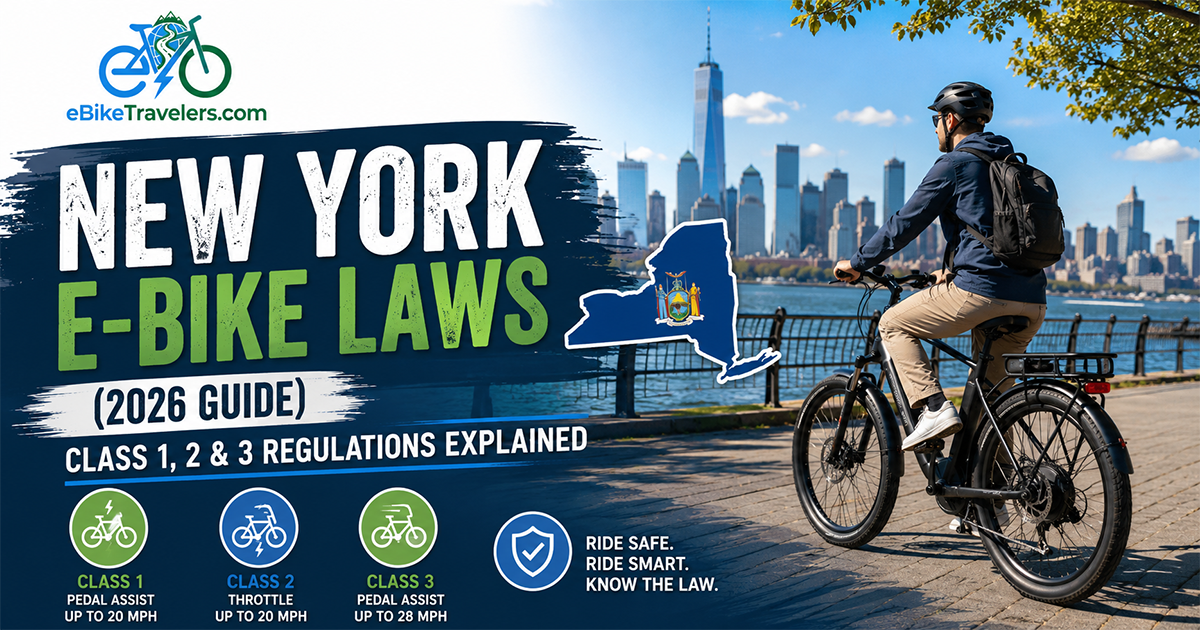
New York E-Bike Laws
2026 Complete Guide
New York has two distinct sets of e-bike rules: state law and New York City law. This guide covers both — classifications, the NYC 15 mph speed cap, helmet rules, age requirements, UL battery certification, where you can ride, and how enforcement changed in 2026.
Key 2025–2026 Updates: New York City’s 15 mph citywide speed limit for all e-bikes took effect October 24, 2025. Mayor Mamdani ended criminal enforcement of low-level e-bike violations in March 2026 — officers now issue civil tickets. NYC’s Local Law 39 UL battery certification requirement remains in full effect. Class 3 e-bikes are still only legal within NYC — not in the rest of New York State. All details below.
New York is unique in that NYC has its own distinct e-bike regulations that go beyond — and in some cases differ significantly from — the statewide rules. Before riding, know which jurisdiction applies to you.
- Classes allowed: Class 1 and Class 2 only
- Class 3 is prohibited everywhere outside NYC
- Max speed: 20 mph (state law)
- Roads: Streets with posted limits ≤30 mph
- Sidewalks: Prohibited unless local law allows
- Min. age: 16 for any e-bike
- Helmet: Under 14 required; Class 3 N/A outside NYC
- License / Registration: Not required
- Municipalities may add further restrictions
- Classes allowed: Class 1, 2, and 3 (NYC only)
- NYC speed cap: 15 mph for all classes (eff. Oct 24, 2025)
- Roads: Bike lanes and streets with posted limits ≤30 mph
- Sidewalks: Prohibited citywide
- Min. age: 16 for any e-bike
- Helmet: Required for Class 3 (all ages); 16–17 working cyclists
- Battery cert.: UL 2849 required for all new sales (Local Law 39)
- Delivery riders: Helmet required; DOT safety rules apply
- Parks pilot: E-bikes permitted on park drives through Dec 31, 2026
New York uses the standard three-class federal framework — with one critical state-specific twist: Class 3 is only legal in New York City. Here’s how each class works under New York Vehicle and Traffic Law (VTL §102-c).
Class 1 — Pedal Assist
Motor assists only while pedaling. Assistance cuts off at 20 mph. No throttle permitted. Legal throughout all of New York State. Widest trail and path access.
Class 2 — Throttle Assist
Throttle can propel the bike without pedaling. Motor still capped at 20 mph. Legal statewide. Most common class used by NYC delivery workers. Some path restrictions apply.
Class 3 — Speed Pedelec
Pedal assist up to 25 mph (New York’s Class 3 cap; note: not 28 mph like most states). Legal only in NYC. Helmet required for all riders. NYC’s 15 mph cap still applies.
| Rule | Class 1 | Class 2 | Class 3 (NYC only) |
|---|---|---|---|
| Max Assisted Speed (State) | 20 mph | 20 mph | 25 mph |
| Max Speed in NYC | 15 mph (cap) | 15 mph (cap) | 15 mph (cap) |
| Throttle | Not Allowed | Allowed | Not Allowed |
| Legal Outside NYC | Yes | Yes | No — NYC Only |
| Minimum Age | 16 statewide | 16 statewide | 16 (NYC only) |
| Helmet — Under 14 | Required | Required | Required |
| Helmet — Ages 16–17 | Required if delivery worker | Required if delivery worker | Required (all) |
| Helmet — Adults 18+ | Not Required (rec. always) | Not Required (rec. always) | Required in NYC |
| Bike Lanes | Allowed | Allowed | Allowed in NYC |
| Roads (speed limit) | ≤30 mph posted | ≤30 mph posted | ≤30 mph posted (NYC) |
| Sidewalks | Prohibited (NYC & most areas) | Prohibited (NYC & most areas) | Prohibited |
| State Park Trails | Paved/improved only | Paved/improved only | Prohibited |
| License / Registration | Not Required | Not Required | Not Required |
| NYC UL Battery Cert. | Required (new sales in NYC) | Required (new sales in NYC) | Required (new sales in NYC) |
| Max Width | 36 inches | 36 inches | 36 inches |
🗽 New York City — Key Rules & 2025–2026 Updates
NYC operates under its own layer of e-bike regulations on top of state law. For the millions of riders, delivery workers, and commuters in the five boroughs, here’s what matters most in 2026.
15 mph Speed Cap
All e-bikes and e-scooters are limited to 15 mph on NYC streets and in parks (effective Oct 24, 2025). This overrides each class’s statutory top speed. NYC DOT is developing enforcement technology; the NYPD focuses on education and warnings for first-time violations.
UL Battery Certification
Local Law 39 (eff. Sep 2023) requires all e-bikes, e-scooters, and batteries sold, leased, or rented in NYC to meet UL 2849 (e-bike system), UL 2272 (scooters), or UL 2271 (batteries) standards. Motivated by 268 lithium-ion battery fires in 2023 that caused 18 deaths. Battery fires dropped sharply after enforcement began.
Civil Enforcement (March 2026)
Mayor Mamdani ended criminal enforcement of low-level cyclist and e-bike violations effective March 27, 2026. NYPD now issues civil traffic tickets for violations like running red lights and wrong-way riding — the same process as motor vehicle tickets. This replaced the Adams-era criminal “pink summonses” policy.
Delivery Rider Rules
Commercial delivery cyclists must wear helmets at all times regardless of class or age. Businesses must provide helmets to workers. NYC DOT has specific commercial delivery cyclist safety requirements and an active enforcement program. Delivery riders are also required to follow all traffic rules, including the 15 mph cap.
Parks Micromobility Pilot
The NYC Parks Electric Micromobility Pilot (June 2023–December 31, 2026) allows all three e-bike classes plus e-scooters on park drives only — not pedestrian paths. The 15 mph citywide cap applies inside parks. After December 31, 2026, NYC Parks must decide whether to make park access permanent.
Hudson River Park Exception
The Hudson River Park Trust prohibits e-bikes and motorized devices on its esplanades, piers, and the adjacent bike path. This is governed by the Trust’s own rules under the Hudson River Park Act — not NYC DOT rules. Riders using the west side path should be aware of this specific restriction.
Age Requirements
New York State minimum age:
- Must be 16 years old to operate any class of e-bike statewide
- No exceptions for Class 1 or Class 2 — 16 is the floor for all classes
- Riders under 16 may not legally operate any e-bike on New York public roads
- Local municipalities may impose stricter age rules
Helmet Requirements
Statewide helmet rules by rider:
- Under 14: helmet required on any bike (standard NY bicycle law)
- Ages 16–17 who are working delivery cyclists: helmet required on Class 1 or 2
- All Class 3 riders (NYC only): helmet required regardless of age
- Adults on Class 1 or 2: no state mandate, but strongly recommended
- NYC MVC recommends helmets for all e-bike riders
Motor & Speed Rules
- Max motor power: 750W (federal standard)
- Max width: 36 inches (NY-specific requirement)
- Class 1 & 2: 20 mph state cap; 15 mph in NYC
- Class 3: 25 mph state cap; 15 mph in NYC (NYC cap overrides)
- E-bikes must carry a permanent manufacturer label showing class, max speed, and wattage
- Do not modify motor or speed systems — reclassification as a moped requires registration and insurance
Battery Safety (NYC)
- NYC Local Law 39 (eff. Sep 2023): all e-bikes and batteries sold/rented in NYC must be UL 2849 certified
- Certification must be verifiable — look for UL marks on battery and charger
- Uncertified batteries are the leading cause of e-bike fires in NYC
- FDNY recommends using OEM chargers and not charging unattended overnight
- End-of-life lithium-ion batteries are hazardous waste — do not trash them
Required Equipment
- White front light when riding after dark
- Red or amber rear light or reflector at night
- Audible bell or horn
- Functioning brakes on both wheels
- Reflectors (front, rear, and sides)
- Permanent manufacturer class label on the frame
License & Registration
- No driver’s license required for any class
- No vehicle registration, plate, or VIN required
- No insurance required by state or city law
- If your e-bike is modified beyond 750W or 25/20 mph, it may be reclassified as a moped — triggering all motor vehicle requirements
- DUI laws apply: riding while impaired by alcohol or drugs is illegal under VTL
Permitted riding areas depend on your e-bike’s class, whether you’re inside or outside NYC, and the rules of each specific location. Here’s what to expect.
🛣️ Roads & Bike Lanes
- All classes: Allowed on roads with posted limits ≤30 mph
- E-bikes must use bike lanes wherever they are available and usable
- Roads with speed limits over 30 mph are off-limits unless a local law specifically permits
- In NYC, the 15 mph cap applies on all roads and lanes regardless of posted limit
🚲 Shared-Use Paths & Greenways
- Class 1 & 2: Generally allowed on bike paths and greenways statewide
- Class 3: NYC greenways generally allow it; check posted signage
- The Hudson River Park esplanade prohibits all e-bikes under Trust rules
- Municipalities can restrict access — always check local ordinances
🌲 State Parks & Trails
- NY OPRHP (State Parks) allows Class 1 and Class 2 on paved and improved-surface trails
- Class 3 is prohibited in all NY State Parks
- Natural surface and non-motorized trails are generally off-limits to all e-bikes
- Each park unit may have additional specific rules — check before riding
🏙️ NYC Parks (Pilot Program)
- Under the NYC Parks Electric Micromobility Pilot (through Dec 31, 2026), all classes plus e-scooters are permitted on park drives only
- Pedestrian paths and non-designated areas remain off-limits
- The 15 mph citywide cap applies inside parks
- After Dec 31, 2026, NYC Parks will decide whether to make access permanent
New York E-Bike Law: History and What Riders Need to Know in 2026
New York legalized e-bikes statewide in April 2020 after years in which e-bikes existed in a legal gray zone — particularly in New York City, where the NYPD had been actively confiscating e-bikes from delivery workers despite their widespread use. The 2020 legalization established the three-class framework under the Vehicle and Traffic Law and effectively decriminalized the use of Class 1, Class 2, and (within NYC) Class 3 e-bikes on public roads and bike infrastructure.
The years since legalization have brought layered additional regulation — particularly in NYC, which has become one of the most active e-bike regulatory environments in the country. Battery fires, delivery worker safety concerns, and the explosion of high-powered e-bikes that push or exceed the legal definition of an e-bike have each driven new rules.
Why NYC Has a 15 mph Speed Cap
New York City’s 15 mph citywide speed limit for all e-bikes — effective October 24, 2025 — was the result of a safety initiative launched by Mayor Adams in June 2025, prompted in part by the rapid increase in e-bike-related pedestrian injuries and crashes. The statutory class definitions still allow Class 1 and 2 bikes up to 20 mph and Class 3 bikes up to 25 mph, but NYC’s DOT regulation overrides these maximums within the five boroughs.
As of April 2026, the City Council introduced Intro 1312-2025 to codify the 15 mph limit into the NYC Administrative Code, which would give it stronger and more permanent legal standing than a DOT regulation. The NYPD’s stated enforcement approach focuses on education first, with warnings for first-time violators and civil tickets for repeat offenses. Riders are currently expected to self-regulate their speed.
The NYC Battery Fire Crisis and Local Law 39
The regulatory environment in NYC was dramatically reshaped by a surge in lithium-ion battery fires. In 2023, the FDNY responded to 268 lithium-ion battery fires that caused 18 fatalities and 150 injuries — the vast majority linked to uncertified e-bike and e-scooter batteries. Local Law 39, which took effect September 2023, prohibits the sale, lease, or rental of any e-bike, e-scooter, or battery in NYC that doesn’t meet UL certification standards (UL 2849 for e-bike systems, UL 2271 for batteries).
The law targets retailers, not individual owners, but in practice it means that only UL-certified e-bikes have been legally sold in NYC since late 2023. The FDNY reported that battery fire deaths dropped from 18 in 2023 to 6 in 2024, a reduction attributed to Local Law 39 enforcement combined with public education and a battery-exchange program. For buyers: always look for the UL certification mark on both the battery and the charger — not just the packaging.
The Shift in NYPD Enforcement (March 2026)
One of the most significant changes for everyday NYC riders in 2026 happened in March, when Mayor Mamdani announced the end of criminal enforcement for low-level cyclist and e-bike traffic offenses. The directive took effect March 27, 2026. Under the prior Adams administration, the NYPD had issued criminal “pink summonses” for violations like running red lights, riding the wrong way, stop sign violations, and DUI-related offenses on e-bikes. This policy had been criticized for disproportionately targeting delivery workers, who often faced criminal records for minor traffic infractions.
Under the new approach, officers issue civil traffic tickets for the same violations — identical to the process used for motor vehicle drivers. This doesn’t mean the rules changed, just that the enforcement mechanism is less severe. Running a red light on an e-bike is still illegal; it just won’t generate a criminal record.
New York’s Unique Class 3 Rule
New York has one of the most unusual Class 3 rules in the country. While most states either ban Class 3 entirely or allow it statewide, New York takes a middle path: Class 3 is legal only in cities with a population of one million or more. Since New York City is the only city in New York State that meets this threshold (NYC’s population exceeds 7 million; the next largest city, Hempstead Town, has under 800,000 people), this effectively means Class 3 is exclusive to NYC.
Additionally, New York’s Class 3 definition differs from most states: the speed cap is 25 mph, not the 28 mph used in California, Colorado, and most other states. This means a 28 mph e-bike sold and marketed as “Class 3” in most of the country does not meet New York’s statutory definition. Riders should verify their bike’s specs before riding a faster e-bike in New York State.
Delivery Workers: A Special Case in NYC
New York City has a massive and well-organized delivery worker community — tens of thousands of cyclists who rely on e-bikes for their livelihoods. NYC’s e-bike regulations include specific provisions for commercial delivery cyclists that don’t apply to recreational or commuter riders. All delivery workers must wear helmets regardless of class or age. Businesses employing delivery cyclists must provide helmets to their workers. The NYC DOT has a dedicated commercial cycling program with educational materials, safety requirements, and a process for reporting violations.
The intersection of labor law and e-bike regulation has made delivery workers one of the most visible e-bike policy constituencies in the city. Advocacy organizations including Los Deliveristas Unidos have been active in shaping enforcement policies, and the shift away from criminal pink summonses in 2026 was in part a response to their advocacy.
No. Under New York Vehicle and Traffic Law, Class 3 e-bikes may only be operated in cities with a population of one million or more. New York City is the only city in New York State that meets this threshold. Class 3 is prohibited in Albany, Buffalo, Rochester, Syracuse, and every other New York city and town outside the five boroughs. If you’re riding anywhere outside NYC, you’re limited to Class 1 (pedal-assist to 20 mph) and Class 2 (throttle to 20 mph).
Yes — it applies to all three classes and took effect October 24, 2025. The NYC DOT 15 mph cap overrides the statutory class speed limits within the five boroughs. This means even Class 3 e-bikes (which can legally assist up to 25 mph under state law) are restricted to 15 mph when riding in NYC. The limit applies on all city streets, bike lanes, and park drives. Intro 1312-2025 is pending in the City Council to codify this limit into law. Enforcement is currently civil (tickets), not criminal.
No. For legal Class 1, 2, and (in NYC) Class 3 e-bikes, New York State does not require a driver’s license, vehicle registration, VIN, license plate, or insurance. E-bikes are treated as unregistered bicycles under state law, not motor vehicles. However, if your e-bike is modified beyond the legal class specifications — particularly if the motor exceeds 750W or assists beyond 25/20 mph — it may be reclassified as a moped or motor vehicle, triggering registration, insurance, and licensing requirements.
Under NYC Local Law 39 (effective September 2023), all e-bikes, e-scooters, and batteries sold, leased, or rented in New York City must meet UL certification standards: UL 2849 for e-bike systems, UL 2272 for e-scooters, and UL 2271 for lithium-ion batteries. This rule targets retailers, not individual owners — existing bikes you already own are not required to be retrofitted. However, if you replace the battery or charger, the replacement should be certified. Look for the UL certification mark on the battery unit and charger, not just the packaging.
On park drives, yes — under the NYC Parks Electric Micromobility Pilot (active through December 31, 2026), all three e-bike classes and e-scooters are permitted on park drives in NYC parks, including Central Park. The 15 mph citywide speed cap applies. Pedestrian paths, lawns, and non-designated areas remain off-limits to e-bikes. After December 31, 2026, NYC Parks will decide whether to make this access permanent. However, the Hudson River Park Trust independently prohibits e-bikes on its esplanades and adjacent bike path — this is a separate prohibition not covered by the Parks pilot.
Throttles are legal only on Class 2 e-bikes in New York. Class 1 and Class 3 are pedal-assist only — throttles are not permitted on these classes. Class 2 with a throttle is legal statewide (not just in NYC) and is the most common type among NYC delivery workers. The throttle cannot assist the rider beyond 20 mph.
It depends on your class, age, and whether you’re a delivery worker. Under 14: helmet required on any bike (standard bicycle law). Ages 16–17 working as delivery cyclists: helmet required on Class 1 or 2. All Class 3 riders in NYC: helmet required regardless of age. Adults on Class 1 or Class 2 who aren’t delivery workers: no statewide mandate, but strongly recommended. NYC’s official guidance recommends helmets for all riders regardless of legal requirements, especially given the 15 mph speed cap environment and dense urban traffic.
In New York City, no — sidewalk riding is prohibited citywide for all e-bikes. Statewide, sidewalk riding is also prohibited under state law unless a local ordinance specifically permits it. In practice, most New York municipalities prohibit e-bikes on sidewalks. Outside of NYC, some smaller towns or rural areas may have local exceptions, but these must be explicitly established by local ordinance. When in doubt, assume sidewalk riding is not permitted and use the road or bike lane.
The minimum age to operate any class of e-bike in New York State is 16 years old. This applies to Class 1, Class 2, and Class 3 — there is no exception for slower bikes. Riders under 16 may not legally operate an e-bike on public roads in New York. Local municipalities may set stricter age limits. In NYC, riders under 14 must wear a helmet under standard bicycle law.