
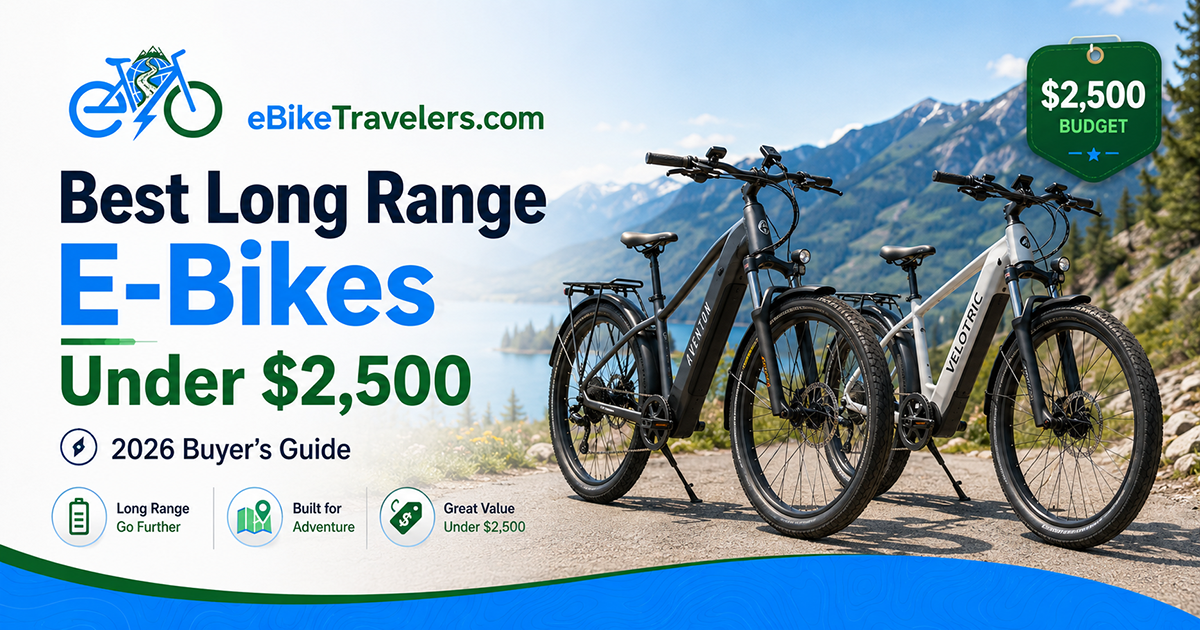
Best Long-Range E-Bikes
Under $2,500
Real range without the $3k–$6k price tag. This guide covers the top value-per-mile picks, the range myths every buyer falls for, and the simple setup changes that add miles to every charge — no hardware upgrades needed.
Every “up to X miles” claim on an e-bike spec sheet is measured under ideal conditions — flat terrain, light rider, Eco mode, low speed. Your actual range depends on five real-world variables. Know them before you choose a model.
Planning Rule: For a loaded real-world day on mixed terrain, plan around 55–65% of the advertised “up to” range. A bike claiming 80 miles will deliver around 45–52 miles in typical touring conditions. Use the advertised number to compare models — not to plan your actual route.
🔋 Want 200-Mile Range? Check Aniioki & Philodo
Our affiliate partners offer long-range e-bikes with 52V–60V batteries and dual-motor options that go far beyond the $2,500 mainstream market.
All picks below are based on advertised range + battery size + real-world value. Range marked with * is manufacturer-stated “up to” figures — see the Reality Check above for what to actually expect.
| Model | Adv. Range* | Battery | Price | Best For | Category |
|---|---|---|---|---|---|
| Lectric XP Lite 2.0 LR | 80 mi | LR battery option | Under $999 | Starter long-range | Budget Range |
| Aventon Level.2 | 60 mi | Standard pack | ~$1,499 | City + fitness miles | Commuter Sweet Spot |
| Velotric Discover 2 | 75 mi | 705.6 Wh | ~$1,799 | Long commutes | High-Cap Commuter |
| Lectric XPedition Dual Battery | 120 mi | Dual pack | Under $2,500 | Cargo + all-day range | Car-Replacement |
| Lectric XP4 750 | 85 mi | Standard | ~$1,299 | Value miles-per-dollar | Budget Range Monster |
| TENWAYS Wayfarer | 85 mi | Large capacity | ~$2,199 | Low-maintenance commuting | Belt Drive |
*All range figures are manufacturer “up to” claims under optimal conditions. Real-world range is typically 55–65% of stated maximum on mixed terrain.
What each bike does well, who it’s for, and what you need to know before you buy.
The XP Lite 2.0 Long-Range is the ideal entry point for budget buyers who want real distance. Lectric’s long-range battery option gives claimed 80-mile capability — more than enough for most commuters and weekend riders who’ve been stretching a single charge. The lightweight build (for an e-bike) makes it practical for apartments and car racks. Real-world testers typically see 45–55 miles on mixed terrain, which still beats most bikes in this price bracket. Use lower assist + steady cadence on longer days and you’ll approach the upper range of the claimed figure. The best “first long-range e-bike” if price sensitivity is the primary constraint.
The Level.2 is Aventon’s benchmark commuter — and it earns that position through the combination of a torque sensor (notably rare at this price), solid geometry, and a consistently praised real-world feel. The claimed 60 miles is realistic for moderate commutes — real-world testers on 20–35 mile daily loops consistently get 2+ days between charges on Tour mode. Where the Level.2 wins: it’s actually comfortable for the distances it’s designed to cover. Comfort is the limiting factor in long-range riding before battery in many cases. A commuter that has you in pain after 25 miles isn’t a “long-range” bike regardless of the spec sheet.
The Discover 2 stands out for one reason: Velotric put a genuinely large 705.6 Wh battery in a commuter-priced bike. That’s a touring-tier battery capacity at a commuter price point. Max range of 75 miles on paper means real-world riders consistently see 40–55 miles on mixed terrain without the assist discipline required on smaller-battery bikes. For riders whose commute is 25–35 miles each way — where most similarly priced bikes create range anxiety — the Discover 2 removes the mental overhead. Strong commuter geometry, integrated lighting, and solid component quality round out a bike that’s genuinely built around the “go farther” mission.
120 miles is the headline, but the real story is what dual batteries mean practically: you stop thinking about range entirely. For errands, grocery runs, kid hauling, and multi-stop daily logistics, the XPedition with dual batteries is as close to “just ride” as an e-bike gets under $2,500. Real-world riders report 60–80+ miles on mixed terrain with cargo loads — still class-leading at this price. The cargo utility adds another dimension: with a rear rack rated for serious loads, this bike genuinely replaces car trips that a traditional single-battery commuter can’t. One important note: the dual-battery XPedition is heavier than single-battery commuters — factor in storage and rack-loading considerations before buying.
Wired’s real-world test is the most important data point for this bike: claimed 85 miles, real-world 50+ miles on hilly terrain with a heavier rider. That’s genuinely strong for a bike at this price point — most bikes in this range don’t survive scrutiny from independent reviewers, but the XP4 does. At around $1,299 for the 750 version, it offers one of the best miles-per-dollar ratios of any e-bike on the market. The 750W motor handles hills and load well. The trade-off: it’s heavier and bulkier than the Lectric Lite, and the component quality reflects the price. Tire pressure discipline and speed management are the two variables that most affect real-world range — budget riders who read the range tips section of this guide will outperform riders who just ride hard.
The Wayfarer’s selling proposition is the combination of claimed 85-mile range with belt drive drivetrain — a pairing that addresses the most common pain point of high-mileage commuters: maintenance. A belt drive requires essentially zero maintenance compared to a chain — no lubrication, no degreasing, no rust, no chain stretch. For riders who log serious weekly mileage (100+ miles/week), the maintenance savings over a year are meaningful. Priced at $2,199 (with noted launch discounts), it’s the premium pick in this guide. The range claim still needs the usual real-world reduction applied — but for the right commuter, the maintenance-free equation makes the price worthwhile.
Most “range problems” are setup problems. These are the fastest, cheapest wins for any e-bike rider looking to go farther per charge.
Lower Assist + Steady Cadence
The single most impactful change. The motor draws significantly less current at lower assist levels. Use the lowest assist that maintains your desired speed on flat sections — save higher modes for hills and headwinds only. The battery stays in an efficient output zone longer, which extends range disproportionately.
Maintain Correct Tire Pressure
Low tire pressure dramatically increases rolling resistance. On an e-bike, this translates directly to faster battery drain. Check weekly — most e-bike tires run 35–65 PSI depending on tire size. Check the sidewall for the recommended range. Fat tire riders: run 10–20 PSI for pavement, lower for off-road — but never neglect this check before a long ride.
Smooth Acceleration — No Surge Riding
Hard acceleration spikes current draw and wastes energy. Start in an easier gear, ramp up speed gradually, and maintain momentum rather than stopping and accelerating repeatedly. For urban riders: coasting through yellow lights instead of sprinting from reds is a meaningful range change over a 30-mile commute.
Battery Care = Long-Term Range
Heat and deep discharges reduce lithium-ion capacity over time — permanently. Store your battery at 40–80% charge when not in use for more than a few days. Avoid leaving it plugged in at 100% for extended periods. Don’t fully discharge regularly. A battery cared for properly retains 80%+ capacity after 500+ charge cycles; one neglected can drop to 70% within a year.
Temperature Management
Cold weather below 40°F can reduce usable battery capacity by up to 20%. Store your e-bike and battery inside overnight before cold-weather rides. On winter days, the first few miles will show lower estimated range — this normalizes as the battery warms up. Don’t charge a very cold battery immediately after a ride; let it reach room temperature first.
Drivetrain Maintenance
A dirty, dry, or stretched chain increases drivetrain friction and reduces efficiency. Clean and lubricate your chain every 100–200 miles of riding. A clean drivetrain can recover 3–5% of range that friction was eating. Belt drive bikes (like the TENWAYS Wayfarer) have essentially zero drivetrain maintenance — one of the practical range advantages of belt drives that never appears in spec sheets.
Quick wins stacked together: A rider who (1) uses Eco mode on flats, (2) maintains correct tire pressure, (3) avoids hard acceleration, and (4) takes care of their battery can typically see 15–25% more real-world range than a rider on the same bike who ignores all four. That’s the difference between a 40-mile day and a 48–50-mile day on the same battery.
What to prioritize — and what to ignore — when evaluating any long-range e-bike under $2,500.
✅ Prioritize These
- Battery capacity (Wh) — Range is energy. More Wh = more potential miles. Minimum 600 Wh for genuine long-range performance.
- Comfort for time-in-saddle — Long rides are limited by comfort before battery in many cases. Geometry, saddle, and handlebar reach matter.
- Hydraulic disc brakes — Long-range means more miles = more stopping events = brakes matter. Non-negotiable above $1,000.
- Service and battery replacement availability — A 3-year-old e-bike with an unavailable proprietary battery pack is a dead e-bike. Choose brands with service history.
- Torque sensor (vs. cadence) — A torque sensor dramatically improves range efficiency by modulating power to your actual pedaling input.
- Real-world reviews from independent testers — Don’t trust manufacturer range claims alone. Find real-world mileage data.
⚠️ Don’t Get Distracted By
- Motor wattage alone — A 500W mid-drive often outperforms a 750W hub motor in real-world range efficiency. Wh and torque matter more.
- “Up to” range claims — These are best-case figures. Always apply the 55–65% real-world correction before planning.
- Top speed — For range, you want to ride slower and more efficiently. Top speed specs have no relevance to long-range performance.
- Weight claims — A few lbs difference between bikes has minimal real-world range impact. Comfort and battery capacity matter far more.
- Unverified “no-name” battery packs — Battery quality and safety certification (UL 2849) matter significantly for both safety and long-term capacity.
- Social media hype — Influencer-promoted bikes have sponsored range tests. Independent reviews from cycling publications are the reliable standard.
For most riders on mixed terrain, a realistic long-range target is 35–65 miles per charge. The models in this guide advertise 60–120 miles, but those figures assume flat terrain, light riders, Eco mode, and low speeds. Apply the 55–65% real-world correction to any “up to” claim. A bike claiming 80 miles will deliver 44–52 miles in real-world touring conditions for a typical rider. Use the range tips in this guide to push toward the upper end of that range without any hardware changes.
Yes, strongly — if you genuinely need all-day range or cargo utility. The Lectric XPedition with dual batteries at under $2,500 delivers the closest thing to “just ride without thinking about range” in this price category. Real-world testers see 60–80+ miles on mixed terrain with cargo loads. The trade-off is weight — the dual-battery XPedition is significantly heavier than single-battery commuters. If your primary use is daily urban commuting under 40 miles round-trip, single-battery bikes with 700+ Wh (like the Velotric Discover 2) are more practical. Dual battery shines for errands, hauling, and multi-stop daily logistics.
Stack these four changes: (1) Use the lowest assist level that’s comfortable for flat sections — save higher modes for hills only. (2) Check and inflate tire pressure weekly — low pressure dramatically increases rolling resistance. (3) Avoid hard acceleration — start slow, build speed gradually. (4) Maintain your chain or drivetrain — friction steals range silently. These four changes combined can deliver 15–25% more real-world range on the same battery, on the same bike, with zero cost. For long-term range, battery storage habits (keeping it at 40–80% charge when stored) preserve capacity over years.
At $1,000, you’re buying a bike that claims long range but achieves it primarily through lower overall efficiency and careful riding discipline — the Lectric XP Lite and XP4 are genuinely strong value but require more rider management to hit their range numbers. At $1,500–$2,500, you get larger battery capacity (700+ Wh), better torque sensor systems that use energy more efficiently, better brakes that matter on longer rides, and generally more reliable build quality for high-mileage use. The Velotric Discover 2 at $1,799 with its 705.6 Wh battery represents the point where range becomes relatively effortless rather than disciplined.
Most bikes in this guide include integrated lights and basic accessories. For long-range riding specifically, the accessories worth adding are: a quality phone mount for navigation ($15–$40), a repair kit with CO₂ inflator ($20–$40), a 25-ft extension cord for charging at accommodations ($15), and a high-lumen rear light if the integrated light isn’t bright enough. For touring use, a rear rack and waterproof panniers ($60–$180 total) are the most impactful additions. All available on Amazon through our accessories guide.
For multi-state touring routes, check the e-bike laws for each state you’ll ride through. Class restrictions vary — Class 3 bikes (28 mph) are restricted or banned on many greenways and multi-use paths. Some states have additional local rules. Our state-by-state guide covers every state with trail access details, helmet laws, and class restrictions. PeopleForBikes also maintains a current state law database as a cross-reference. Always verify the specific trail and greenway rules for your route — state law and trail management rules can differ significantly.