
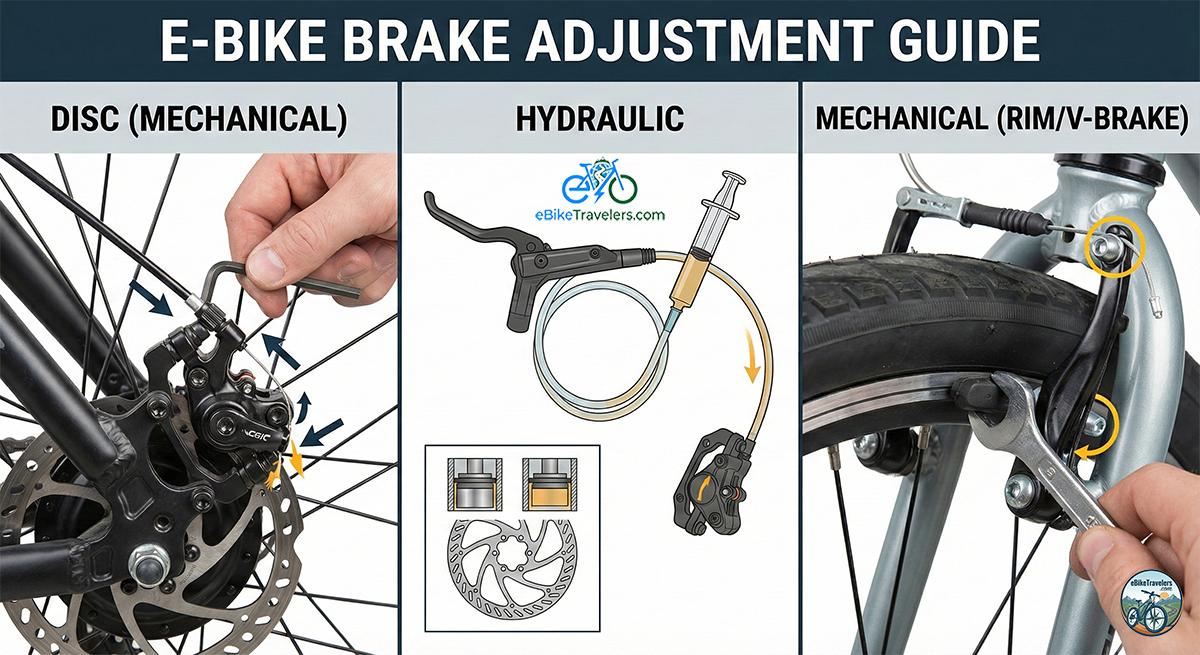
E-Bike Brake Adjustment Guide (Mechanical & Hydraulic)
Proper e-bike brake adjustment is critical for safety. Because e-bikes are heavier and travel at higher speeds than standard bicycles, poorly adjusted brakes dramatically increase stopping distance.
This guide explains how to adjust the most common e-bike braking systems, how to diagnose braking problems, and when it’s time to replace parts instead of adjusting them.
Common E-Bike Brake Types
- Mechanical disc brakes – cable-actuated, simple and DIY-friendly
- Hydraulic disc brakes – fluid-actuated, stronger and smoother
- Rim brakes – rare on modern e-bikes, limited stopping power
Most modern e-bikes use disc brakes because they perform consistently in wet conditions and under heavier loads.
Signs Your E-Bike Brakes Need Adjustment
- Brake lever pulls too close to the handlebar
- Squealing, rubbing, or grinding sounds
- Reduced stopping power
- Brake drag when spinning the wheel
- Uneven braking between front and rear
How to Adjust Mechanical Disc Brakes
Step 1: Center the Caliper
- Loosen the two caliper mounting bolts
- Squeeze and hold the brake lever
- Tighten bolts evenly while holding the lever
Step 2: Adjust Cable Tension
- Use the barrel adjuster at the lever or caliper
- Turn counterclockwise to increase tension
- Aim for firm lever feel without drag
Step 3: Fine-Tune Pad Clearance
Some mechanical brakes have an inner pad adjustment knob. Turn slightly to reduce lever travel and improve bite.
How to Adjust Hydraulic Disc Brakes
Hydraulic brakes self-adjust for pad wear. If braking feels weak, adjustment usually means pad inspection or rotor alignment — not cable tension.
Re-Center the Caliper
- Loosen caliper mounting bolts
- Squeeze brake lever firmly
- Tighten bolts evenly
Check Pad Thickness
- Replace pads if under 1mm thick
- Contaminated pads must be replaced
Brake Rotor Issues & Alignment
- Rotor rubbing: caliper misalignment or bent rotor
- Squealing: contamination or glazing
- Pulsing brake feel: warped rotor
Clean rotors using isopropyl alcohol only. Never touch braking surfaces with bare hands.
When Adjustment Is Not Enough
- Brake pads worn below minimum thickness
- Rotor warped or below minimum thickness
- Hydraulic fluid leaks
- Cables frayed or corroded
Shop Brake Tools & Pads
How to Keep E-Bike Brakes Working Properly
- Inspect brakes weekly
- Avoid contaminating pads with oil or cleaner
- Replace pads early on heavy or hilly rides
- Clean rotors regularly
FAQs: E-Bike Brake Adjustment
Do e-bike brakes need adjustment more often?
Yes. Extra weight and higher speeds cause faster pad wear, especially on rear brakes.
Can I convert mechanical brakes to hydraulic?
Often yes, but compatibility depends on frame mounts, lever compatibility, and rotor size.
Why do my brakes squeal after adjustment?
Squealing is usually caused by contamination, glazing, or improper caliper alignment.