
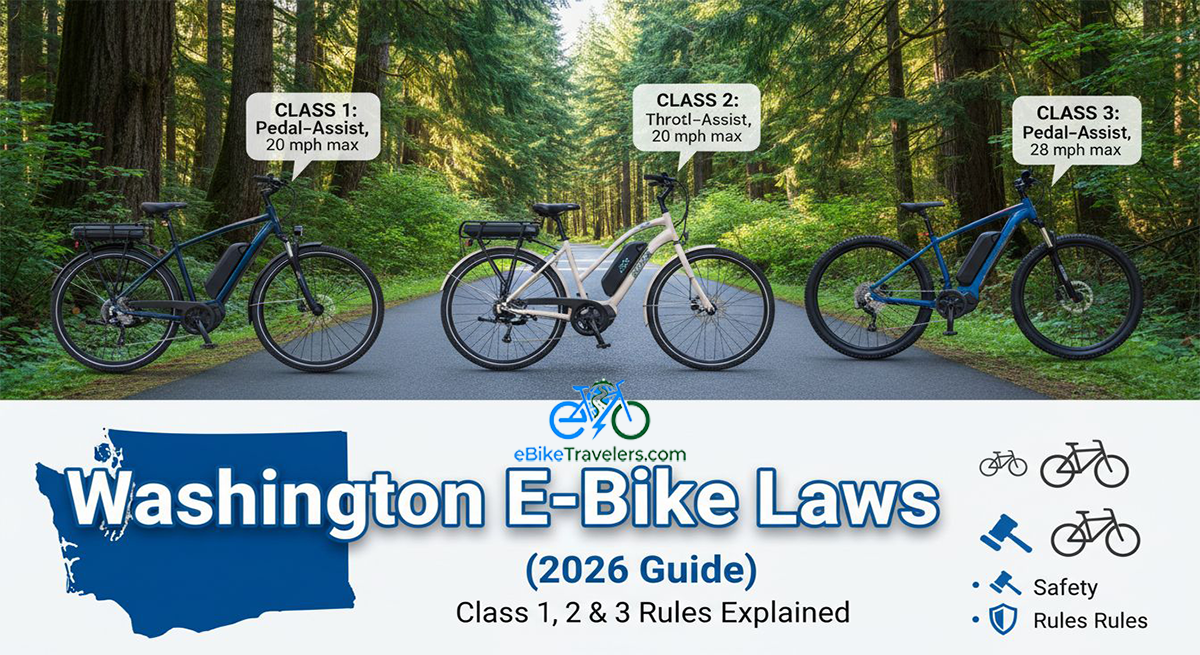
Washington E-Bike Laws
2026 Complete Guide
Washington keeps e-bikes license-, registration-, and insurance-free — but a new law tightens exactly what counts as an “e-bike” in the first place. SB 6110, effective June 11, 2026, excludes throttle devices that exceed 20 mph on motor power alone and closes the loophole for easily-reconfigured “multi-mode” bikes. Here’s the full class system, trail access rules, and what changed.
2026 Legislative Update — SB 6110: Signed March 23, 2026 (Chapter 159, Laws of 2026) and effective June 11, 2026, SB 6110 tightens Washington’s legal definition of “electric-assisted bicycle” under RCW 46.04.169. Two categories of devices no longer qualify as e-bikes: (1) anything capable of exceeding 20 mph on motor power alone, without pedaling, and (2) anything designed or intended to be easily reconfigured past Washington’s e-bike speed or wattage limits. Devices that fail this test are reclassified as electric motorcycles, requiring a motorcycle endorsement to ride. The core three-class framework, 750W cap, and no-license policy for compliant e-bikes are unchanged.
Washington defines electric-assisted bicycles under RCW 46.04.169 as bicycles with two or three wheels, a saddle, fully operative pedals, and a motor of no more than 750 watts. As of June 11, 2026, SB 6110 adds two exclusions on top of this baseline — covered in detail below.
Class 1 — Pedal Assist
Motor assists only while pedaling. Assistance ceases at 20 mph. No throttle. Broadest access statewide — allowed on shared-use paths, bike lanes, and most trails.
Class 2 — Throttle Assist
Throttle can propel the bike without pedaling, but motor is still capped at 20 mph. Same access as Class 1 on most facilities. Under SB 6110, throttle bikes that can exceed 20 mph on motor power alone no longer qualify as e-bikes at all.
Class 3 — Speed Pedelec
Pedal assist up to 28 mph. Riders must be at least 16 years old. Not allowed on sidewalks or most shared-use paths unless a local jurisdiction specifically permits it.
| Rule | Class 1 | Class 2 | Class 3 |
|---|---|---|---|
| Max Assisted Speed | 20 mph | 20 mph | 28 mph |
| Throttle | Not Allowed | Allowed (≤20 mph only) | Not Allowed |
| Minimum Age | None statewide | None statewide | 16 years old |
| Statewide Helmet Law | None | None | None |
| Roadways | Allowed | Allowed | Allowed (highway-adjacent) |
| Shared-Use Paths | Allowed | Allowed | Not Allowed unless local exception |
| Sidewalks | Local rules apply | Local rules apply | Not allowed unless local exception |
| King County Regional Trails | Allowed, 15 mph cap | Allowed, 15 mph cap | Prohibited |
| SB 6110 Reclassification Risk | Low | Check throttle-only top speed | Check for reconfigurable modes |
| License / Registration | Not Required | Not Required | Not Required |
| Insurance | Not Required | Not Required | Not Required |
| Class Label Required | Yes — RCW 46.37.690 | Yes — RCW 46.37.690 | Yes — RCW 46.37.690 |
🍃 SB 6110: Washington’s 2026 E-Bike vs. E-Motorcycle Line
SB 6110 (Chapter 159, Laws of 2026) was signed by the Governor on March 23, 2026 and took effect June 11, 2026. It doesn’t touch the three-class framework or add any new license, registration, or insurance requirement for compliant e-bikes — its entire purpose is to tighten who qualifies as riding an “e-bike” in the first place, separating true pedal bicycles from the flood of high-powered throttle devices increasingly marketed as e-bikes.
Throttle-Over-20-mph Devices Excluded
Any device capable of exceeding 20 mph solely on electric motor power — without the rider pedaling — no longer qualifies as an e-bike under Washington law, regardless of wattage rating. These fall under separate motor vehicle or motorcycle regulations instead.
Easily-Reconfigurable Bikes Excluded
Any device designed, manufactured, or intended to be easily configured to exceed Washington’s e-bike speed or wattage limits is also excluded — closing the loophole for “multi-mode” bikes that can be field-modified out of class with a firmware toggle or unlock code.
Core Requirements Unchanged
Compliant e-bikes must still have two or three wheels, a saddle, fully operative pedals, and a motor of 750W or less. Nothing about Class 1, 2, or 3 definitions, age rules, or trail access changed — only the outer boundary of what counts as an e-bike at all.
Reclassified Devices = Electric Motorcycles
A device that fails the SB 6110 test is treated as an electric motorcycle, not a moped. Riding one requires a driver’s license and a motorcycle endorsement — a meaningfully higher bar than Washington’s prior moped-adjacent gray area.
Legislative Work Group
SB 6110 established a work group tasked with developing enforcement guidelines and further recommendations for regulating electric motorcycles. An interim report is due December 15, 2026, with a final report due October 31, 2027.
What This Means If You’re Buying
If you’re shopping for a high-power throttle bike advertised as an “e-bike” — especially anything marketed with an “unlock mode” or top speeds well above 28 mph — verify it meets the RCW 46.04.169 definition before you buy. If it doesn’t, it needs a motorcycle endorsement to ride legally in Washington.
WSDOT WE-Bike Rebate — Round 2 Open Through March 2027
Washington runs the country’s largest income-tiered e-bike rebate program. Funded by Climate Commitment Act revenue at $7 million for the 2025–27 biennium, the WSDOT WE-Bike program offers instant rebates of $300 or $1,200 depending on household income tier. Round 2 applications are open March 30, 2026 through March 29, 2027 for eligible residents age 16 and up. This is separate from SB 6110 and unaffected by it — check current eligibility and participating retailers at wsdot.wa.gov before you buy.
Age Requirements
- Class 1 & 2: No statewide minimum age (local ordinances may set one)
- Class 3: Riders must be at least 16 years old — RCW 46.20.500(3)
- Some school districts restrict e-bike use by students under 16 on school property during school hours
Helmet Requirements
- Washington has no statewide bicycle or e-bike helmet law — one of the few states without one
- King County’s all-ages helmet mandate was repealed February 17, 2022
- About 17 incorporated cities within King County retain their own local helmet ordinances
- A rider whose device fails the SB 6110 e-bike definition and becomes a moped or motor-driven cycle is subject to the statewide motorcycle helmet rule (RCW 46.37.530)
- Helmets strongly recommended regardless of legal requirement, especially at Class 3 speeds
Motor, Speed & SB 6110 Limits
- Maximum motor power: 750W
- Class 1 & 2: Motor assistance ceases at 20 mph
- Class 3: Motor assistance ceases at 28 mph, must include a speedometer
- As of June 11, 2026: devices exceeding 20 mph on motor power alone (no pedaling) are excluded from the e-bike definition entirely
- Devices designed to be easily reconfigured past these limits are also excluded
Required Class Labeling
- New e-bikes must carry a permanent label under RCW 46.37.690 showing class, top assisted speed, and motor wattage
- Tampering with a bike to exceed its labeled top speed without replacing the label is a violation
- Verify the label is present and unaltered before buying a used e-bike
License, Registration & Insurance
- No driver’s license required for a compliant e-bike (RCW 46.20.500)
- No vehicle registration required — Washington’s moped registration rules explicitly exempt electric-assisted bicycles under RCW 46.61.710
- No statutory insurance requirement for a compliant e-bike
- If reclassified as an electric motorcycle under SB 6110, standard motor vehicle licensing, endorsement, and insurance rules apply
Traffic Rules
- Follow the same traffic laws as bicycles — signals, right-of-way, yielding to pedestrians
- Electric-assisted bicycles may use highways of the state and park like bicycles
- Local jurisdictions and state agencies may add facility-specific restrictions on top of the state baseline
State law sets the baseline, but cities, counties, and land-managing agencies can add their own restrictions on facilities they control — this is where most of the real-world variation lives.
🛣️ Roads & Bike Lanes
- All classes may use highways of the state, generally the least complicated place to ride
- Class 1 & 2 may use bicycle-designated portions of the highway
- Class 3 may operate on facilities within or adjacent to a highway
- Electric-assisted bicycles may be parked to the same extent as bicycles
🚲 Shared-Use Paths
- Class 1 & 2: May be operated on shared-use paths unless a local jurisdiction or state agency restricts them
- Class 3: May not be operated on shared-use paths unless specifically allowed by the local jurisdiction — RCW 46.61.710(8)
- RCW 46.61.710(7) explicitly authorizes local jurisdictions to further restrict or limit Class 1 and Class 2 path access
🚸 Sidewalks
- Class 1 & 2 generally treated like bicycles — allowed unless local ordinance restricts
- Class 3 prohibited on sidewalks except where there’s no other safe option (e.g., a bridge with no trail alternative)
- Always check city-specific rules — Seattle, Spokane, Bellevue, and Tacoma each have their own additional guidance
🌲 State Parks & Federal Land
- State Parks generally allow Class 1 on many trails; Class 2 & 3 more often restricted
- DNR and WDFW lands default to motorized-route-only for all classes pending final rulemaking directed by ESSB 5452 (2021)
- USFS and BLM federal lands generally classify e-bikes as motorized unless a trail is specifically designated otherwise
King County Regional Trail Network — E-Bike Access at a Glance
Burke-Gilman Trail
Class 1 & 2 allowed at a 15 mph trail speed cap since June 4, 2024. Class 3 prohibited on this and every other regional trail below.
East Lake Sammamish & Cedar River Trails
Same rule as Burke-Gilman: Class 1 & 2 at 15 mph, Class 3 prohibited. Part of the 175-mile regional network opened in 2024.
Green River, Soos Creek & Lake to Sound Trails
Class 1 & 2 permitted, 15 mph cap. Class 3 excluded network-wide under the same King County policy.
Cross-Kirkland Corridor & Eastrail
Same King County regional-trail rule applies. Always check posted signage, since local cities along the corridor can add further restrictions.
E-Motos and SB 6110: Washington’s crackdown mirrors a national trend — high-powered throttle devices marketed as “e-bikes” that can hit 30, 40, or 50+ mph on motor power alone. Under SB 6110, these devices simply don’t meet the legal definition of an electric-assisted bicycle anymore, regardless of what the manufacturer calls them. If a device can exceed 20 mph without pedaling, or is designed to be unlocked past Washington’s speed/wattage limits, it’s an electric motorcycle under state law — requiring a driver’s license, a motorcycle endorsement, and standard vehicle registration/insurance to ride legally. Riding one on a bike lane, shared-use path, or sidewalk is a statutory violation.
Washington E-Bike Law: What Riders Need to Know in 2026
Washington’s e-bike framework dates back to 2018, when the Legislature passed SB 6434, establishing the three-class system consistent with national standards and giving the industry legal certainty. That original law expanded the definition of “bicycle” to include e-bikes, defined the three classes, and set the rules for where each class could be used. For most of the past eight years, Washington has been one of the more rider-friendly states: no license, no registration, no insurance, and no statewide helmet law for any class.
What changed in 2026 wasn’t the class system itself — it was the boundary around it. As high-powered throttle devices marketed as “e-bikes” but capable of 30-50+ mph became more common nationally, Washington lawmakers moved to close the gap between a genuine pedal-assist bicycle and what is functionally an electric motorcycle wearing a bicycle’s marketing.
Why SB 6110 Passed
SB 6110 responds to the same pressure playing out in other states in 2026: a flood of 1,000W+ devices that blur the line between bicycle and motor vehicle, combined with growing safety concerns about unregulated high-speed devices on shared infrastructure. Rather than adding licensing or insurance burdens to compliant e-bike riders — the approach New Jersey took with its far more sweeping S4834 — Washington chose a narrower fix: tighten the definition itself so that genuinely high-powered or easily-modified devices simply fall outside e-bike law altogether, subject instead to Washington’s existing motorcycle framework.
This is a meaningfully different regulatory philosophy than what’s happening in New Jersey or being proposed in Illinois. Washington isn’t adding new burdens to Class 1, 2, or 3 riders who are already compliant — it’s removing ambiguity about what happens to riders and sellers of devices that were never really e-bikes in the first place.
What the Legislative Work Group Will Decide
SB 6110 didn’t just draw a new line — it created a work group to figure out how to enforce it. That group is developing enforcement guidelines and recommendations specifically for regulating electric motorcycles, with an interim report due December 15, 2026 and a final report due October 31, 2027. Riders and retailers should expect additional guidance — potentially including labeling standards, retailer disclosure requirements, or point-of-sale verification — to follow from this process over the next 18 months.
Local Rules Still Do Most of the Work
Even with SB 6110 in effect, the practical experience of riding in Washington is shaped far more by local rules than by state statute. The clearest example is King County’s 175-mile regional trail network, which opened to Class 1 and Class 2 e-bikes on June 4, 2024 with a 15 mph trail speed cap — while Class 3 remains prohibited on every trail in the network, including the Burke-Gilman, East Lake Sammamish, Cedar River, Green River, Soos Creek, Lake to Sound, Cross-Kirkland Corridor, and Eastrail corridors.
Helmet policy is another area where local rules matter more than state law. Washington has no statewide helmet requirement for bicycles or e-bikes of any class — one of only a handful of states without one. King County’s all-ages helmet mandate, in effect since 1993, was repealed on February 17, 2022, but roughly 17 incorporated cities within the county (about a third of its population) kept their own local ordinances in place. Riders should verify the specific city they’re riding in rather than assuming a countywide default.
The WE-Bike Rebate: Buying Support Alongside New Rules
Even as Washington tightens its e-bike definition, the state continues to actively subsidize e-bike adoption for compliant riders. The WSDOT WE-Bike program — funded through Climate Commitment Act revenue at $7 million for the 2025–27 biennium — offers income-tiered instant rebates of $300 or $1,200 at participating retailers. Round 2 applications opened March 30, 2026 and run through March 29, 2027, for residents age 16 and up. This program is entirely separate from SB 6110 and unaffected by the new e-bike definition, since it only applies to bikes that already meet the state’s Class 1-3 requirements.
SB 6110 (Chapter 159, Laws of 2026) is a Washington law signed March 23, 2026 and effective June 11, 2026. It tightens the legal definition of “electric-assisted bicycle” under RCW 46.04.169 by excluding devices that can exceed 20 mph on motor power alone (without pedaling) and devices designed to be easily reconfigured past Washington’s e-bike speed or wattage limits. It does not add license, registration, or insurance requirements for compliant e-bikes.
No. Compliant Class 1, 2, or 3 e-bikes are not subject to DMV licensing or registration requirements under RCW 46.20.500. SB 6110 did not change this. However, if your device fails the SB 6110 definition test — for example, a throttle bike that can exceed 20 mph without pedaling — it’s treated as an electric motorcycle, which does require a driver’s license, a motorcycle endorsement, and standard registration and insurance.
No. Washington is one of the few states without any statewide bicycle or e-bike helmet requirement. King County’s all-ages helmet mandate was repealed on February 17, 2022, though about 17 incorporated cities within the county still have their own local helmet ordinances. If your device is reclassified as an electric motorcycle under SB 6110, the statewide motorcycle helmet rule under RCW 46.37.530 applies instead.
Generally no. Class 3 e-bikes are prohibited on King County’s entire 175-mile regional trail network — including the Burke-Gilman, East Lake Sammamish, Cedar River, Green River, Soos Creek, Lake to Sound, Cross-Kirkland Corridor, and Eastrail — under a policy that took effect June 4, 2024. Class 1 and Class 2 are allowed on these trails with a 15 mph speed cap. Class 3 is generally restricted to roads and highway-adjacent facilities statewide unless a specific local exception applies.
If your device exceeds 750W, can go faster than 20 mph on motor power alone without pedaling, or is designed to be easily reconfigured past these limits, it no longer qualifies as an e-bike under RCW 46.04.169 as amended by SB 6110. It’s instead classified as an electric motorcycle, requiring a driver’s license, motorcycle endorsement, registration, and insurance to operate legally — and it cannot be ridden on bike lanes, shared-use paths, or sidewalks reserved for bicycles and e-bikes.
Yes. The WSDOT WE-Bike program offers income-tiered instant rebates of $300 or $1,200 at participating retailers, funded at $7 million for the 2025–27 biennium. Round 2 applications are open March 30, 2026 through March 29, 2027, for eligible Washington residents age 16 and up. This program is unrelated to SB 6110 and applies to e-bikes that already meet the state’s Class 1-3 definition.
Class 3 riders must be at least 16 years old under RCW 46.20.500(3). There is no statewide minimum age for Class 1 or Class 2 e-bikes, though local ordinances may set their own age rules, and some school districts restrict e-bike use by students under 16 on school property during school hours.
Yes. RCW 46.61.710(7) explicitly authorizes local jurisdictions to restrict or otherwise limit Class 1 and Class 2 path access, and Class 3 is already excluded from shared-use paths by default under RCW 46.61.710(8) unless a local jurisdiction specifically allows it. This is why trail rules vary so much between counties and cities — always check posted signage before riding an unfamiliar trail.